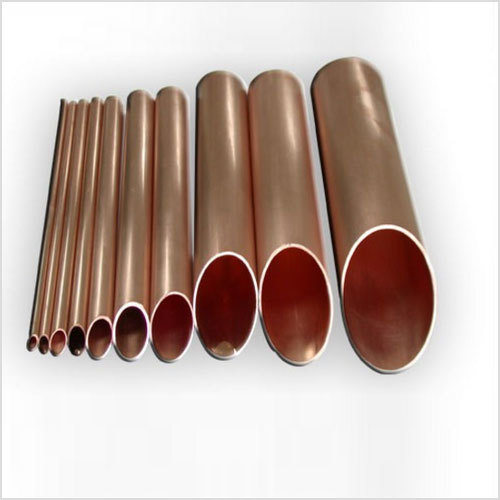
Product Description
| Shape |
Tube |
| Material |
Copper And Nickel |
| Hollow Section |
Circular |
| Range |
90/10 |
| Usage |
Industrial |
| Specification : |
| 90/10 Copper Nickel |
ASTM B 111 C 70600/ ASME SB 111 C 70600/ BS 2871 Part 3 CN 102/ EN 12451 CuNi10 Fe 1Mn/ NFA51 102 CuNi10 Fe1Mn/ JIS H 3300 C 7060 |
| 95/5 Copper Nickel |
ASTM B 111 C 70400/ ASME SB 111 C 70400/ BS 2870 CN 101/ ISO 1635 CuNi5Fe1MN/ JIS C 2532 GCN10 |
Exceptional Corrosion Resistance for Challenging EnvironmentsOur 90/10 Copper Nickel pipes provide excellent resistance to corrosion from seawater and brine, making them highly suitable for use in marine, power plants, and desalination facilities. Their robust finish and high durability contribute to extended service life, minimizing maintenance and replacement costs over time.
Precision Engineering and Versatile ApplicationsCustomizable in terms of diameter, wall thickness, and length, these pipes meet a wide array of project specifications. Available in both seamless and welded types with polished, annealed surfaces, they are used extensively for shipbuilding, heat exchangers, and high-pressure piping systems due to their exceptional thermal and electrical conductivity.
FAQs of JIS H 3300 C 7060 90/10 Copper Nickel Pipe:
Q: How are JIS H 3300 C 7060 90/10 Copper Nickel pipes manufactured?
A: The pipes are produced using advanced cold drawn and annealed techniques, ensuring precise dimensions and consistent mechanical properties. Both seamless and welded types are available, depending on specific project requirements.
Q: What makes these copper nickel pipes suitable for marine and desalination applications?
A: Their 90/10 Copper Nickel composition provides excellent resistance to corrosion caused by seawater and brine, making them ideal for marine structures, shipbuilding, and desalination plants where durability and reliability are critical.
Q: When should custom marking or sizing be requested for an order?
A: Custom marking and sizing should be specified during the order placement process. Dimensions such as inside diameter, wall thickness, and length can be tailored to individual project needs, with custom markings added upon request.
Q: Where are these pipes typically installed?
A: These pipes are commonly installed in marine environments, shipbuilding, desalination units, heat exchangers, and power plants, where their corrosion resistance and pressure-bearing capability are highly beneficial.
Q: What is the process for ensuring high-pressure suitability in these pipes?
A: The pipes are rigorously tested for mechanical strength, including tensile properties and wall thickness consistency, which ensures they meet pressure ratings required for high-pressure applications.
Q: How can the benefit of excellent conductivity be utilized?
A: With notable thermal and electrical conductivity, these pipes are well-suited for heat exchangers and other systems where efficient heat or electrical transfer is essential for operational effectiveness.













 Send Inquiry